

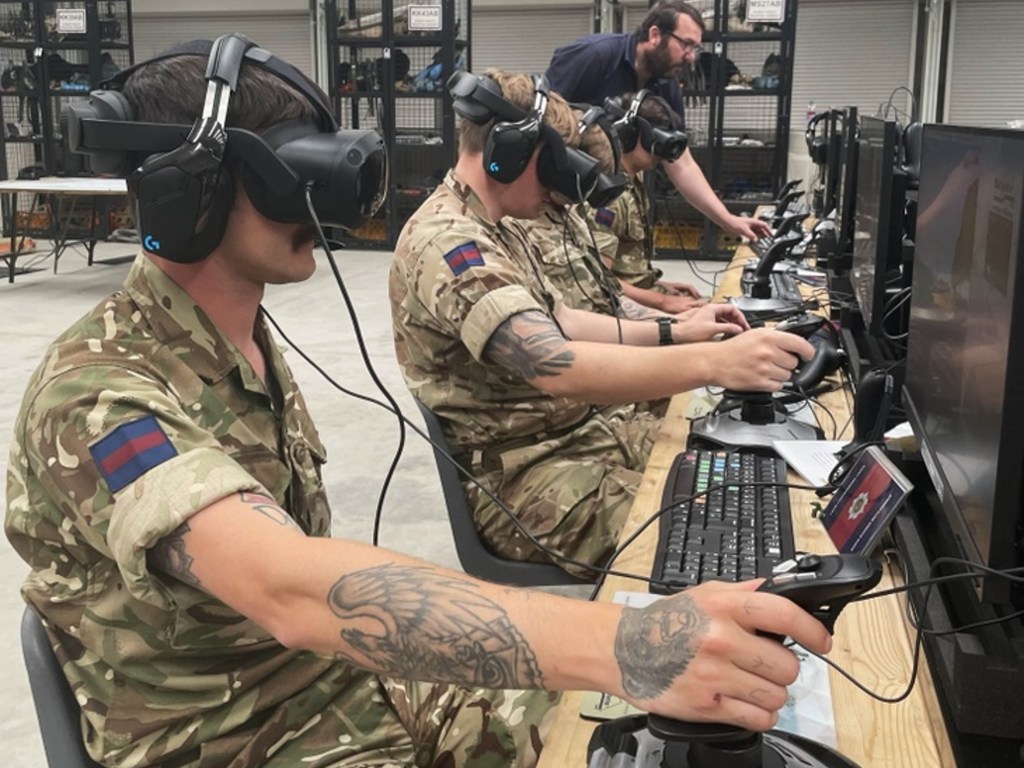
The next podcast “#086 Beyond The Battlefield: Exploring British Army Simulation Training” is a look at the complexities of military simulation and training within the British Army. With former soldier and industry expert, Neale Smiles, we uncover the evolution, challenges, and future of how the Army trains its soldiers using everything from lasers to virtual reality.
Simulation isn’t new to the military; it’s always been used, from blank ammunition to laser-based systems. However, the landscape has changed dramatically over the past couple of decades, particularly with the exponential growth in virtual reality (VR) and the potential of data analytics.
Demystifying the Terminology: It’s More Than Just VR
While many people confuse simulation and virtual reality, simulation is a much broader concept. Neale helped clarify some key terms that define this evolving space:
• Virtual Reality (VR): Most people understand this from computer games like PlayStation and Xbox. It alters a user’s reality by adding digital elements.
• Augmented Reality (AR) / Mixed Reality (MR): These fall under the umbrella term Extended Reality (XR). They also add digital elements to reality, though AR, in particular, is noted as not yet truly viable. An example might be a soldier wearing a headset while physically doing something on the ground, with digital elements layered on top.
• Simulation vs Emulation: While often used interchangeably, emulation tries to copy or imitate a system’s behaviour, whereas simulation creates a model to predict behaviour in different scenarios. The sources suggest that emulators are used more often in military training than simulators, but “simulation” has become the common term.
The typically military way to classify simulation is using the three-letter abbreviation: LVC – Live, Virtual, and Constructive.
• Live: Real people doing real things, like using blank ammunition, battle simulation explosives, or tactical engagement simulation (TES).
• Virtual: Real people doing fake or virtual things.
• Constructive: Fake, aggregated people doing fake, virtual things. This often involves treating groups like a battle group as a single map symbol.
Why Simulate? The Goals of Military Training
At its core, army simulation is about sets and reps – training brain and muscle memory through repetition. It allows soldiers to practice things that might not be feasible or are too risky in peacetime. Simulation can provide more realistic training in certain areas, such as weapon handling drills, before even going to a live range, potentially uncovering incorrect practices that wouldn’t be noticed otherwise. This focus on not wasting training time and saving money are also significant aims. Simulation also offers a way to train effectively without being “smothered in safety checks” that can sometimes detract from realistic training scenarios.
Breaking Down LVC in Practice
During the pod we look at how LVC is used in British Army training today:
Live Simulation:
Tactical Engagement Simulation (TES ): This is described as the “military laser quest system”. It uses lasers on rifles triggered by blank ammunition and receivers on soldiers/vehicles to simulate engagements. It often includes tracking and after-action review packages. Examples include systems such as ‘MILES’. Challenges exist, especially with longer-range modern weapons like Javelin and NLAW, pushing towards laser less TES using concepts like geo-pairing and entity pairing.
Crew Trainers: Full-size models or partial systems for specific vehicles or weapons, like the AS90 turret trainer, the Blue Shell light gun simulator, or MLRS RRPR rounds. The Blue Shell system, for instance, allows artillery crews to practice loading and firing drills using a simulated shell.
Targetry: Full-size target systems for armoured fighting vehicles.
Virtual Simulation:
Small Arms Trainer (SAT) / Dismounted Close Combat Trainer (DCCT): Evolved from older systems, this allows for judgmental shoots and other practices.
Call of Duty Style Environments: Products like VBS4 (Virtual Battle Simulator 4), known as DVS (Defense Virtual Simulation) in the UK, provide military-style computer environments for training. These allow a “real bloke sat at a computer” to train. While graphics are better now (and arguably need to be to engage younger soldiers) they don’t always need Hollywood fidelity, focusing on key tactical elements.
Crew/Unit Level Training: Systems that set up networks of PCs for vehicle crew training. The JFST (Joint Fires Synthetic Trainer) is used for observer routines like calling in fire missions.
Synthetic Wrap (Scopic): This involves adding synthetic elements around live training. For example, flying a virtual UAV over real soldiers wearing TES kit during a live exercise allows the UAV operator to practice their tactical role.
Constructive Simulation:
This is usually found when playing out a plan using a computer system. It’s best described as two map symbols fighting each other, with software calculating the outcomes based on war gaming principles. The best-known British Army example is CAST (Combined Arms Staff Trainer), which uses Abacus software.
Increasingly, the Army is looking to combine these methods, such as Live plus Virtual (L+V), Virtual plus Constructive (V+C), or even aspiring to L+V+C for “whole force training”. This allows for more complex scenarios, though it can create challenges, like balancing artillery training objectives with infantry manoeuvre during a live exercise.
DVS2 – A Training Environment Capable of Simulating Multiple Military Environments and Operations
In 2022 the UK military announced it was significantly enhancing its training capabilities through a new virtual reality system called DVS2, secured under a £7.2 million contract with Bohemia Interactive Simulations (BISim) by Defence Equipment and Support (DE&S). The state-of-the-art, game-based simulation revolutionizes training by bringing the forefront of virtual reality innovation to military exercises.
DVS2 is capable of simulating multiple military environments and operations, allowing soldiers, sailors, and aviators to train anywhere in the world across diverse terrains and with various weapons and equipment. It offers over 100 training scenarios, from piloting fast jets to first aid training, and can be used for individual, team, or joint training alongside NATO allies and other countries using compatible technologies.
This accessible virtual capability provides additional training options beyond traditional physical operations and supports different levels of training, including Dismounted and Mounted training and complex environments tailored using an intuitive Editor tool. The MOD stated that the introduction of DVS2 marks a significant step in transforming Army training, providing a richer, more demanding virtual environment and creating immersive training experiences.
The Hurdles: Cost, Procurement, Data, and Culture
Despite the potential, simulation in the British Army faces significant challenges:
Cost: Contrary to the layman’s expectation, military simulation is often not cheap. Tender processes can wrap what should be inexpensive solutions into large, costly contracts. This can lead to procurement demanding the same artifacts and costs as real capability.
Procurement Process: The requirements-driven tender system is highlighted as a major problem. It can stifle innovation from smaller companies. Units may struggle to acquire even basic simulation kit due to high costs and limited budgets. The speed of procurement is slow compared to the pace of technological change (like drones).
Coverage & Quantity: Even good systems like roundless TES are procured in insufficient numbers (e.g. 3 sets for 49 infantry battalions). This limits the ability to build muscle memory through repetition and means many units and cap badges, particularly the reserves, get limited access to simulation.
Data & Analytics: While valuable, current TES data is often not a “true and complete contextual reflection” of what happened. Data analytics for this purpose is still in early stages. Achieving football stadium-level tracking accuracy and speed would require a massive increase in receivers and better gear. The focus is often on immediate debriefing rather than long-term performance analysis.
Acceptance & Culture: Some “influential luddites” still view simulation as just “playing games”. There’s a danger that if simulation doesn’t work perfectly immediately, it gets discarded. Procurement can have a “blind spot,” forgetting simulation isn’t real kit. Users may not fully understand how to exploit simulation best.
Towards Better Training: The “Dirty Dozen” Recommendations
Neale outlines a “dirty dozen” list of principles for what military simulation training should be like:
- Augment Training, Don’t Just Save Costs: Primarily enhance training, not just cut expenses or ammo.
- Remember It Isn’t Real: Get as close to real as possible, but understand its limitations.
- Be Cheap and Affordable: Avoid expensive, support-contract-heavy systems.
- Be Imagination-Driven: Foster innovation from the ground up, like the “man in the shed” approach.
- Be Vocationally Focused: Integrate seamlessly into soldiers’ roles; it shouldn’t need a user guide.
- Use Hybridized Hardware (Metalverse): Bring synthetic elements to life using real kit or models where possible.
- Be Procured in Adequate Amounts: Ensure enough kit for widespread use and repetition.
- Be Ubiquitous: Available across all cap badges and roles, not just combat arms.
- Be Seamless for Regular and Reserve: Provide reserves with simulation access to enhance their readiness.
- Be Off-the-Shelf and Cobbled Together: Encourage mission command and rapid adoption of available technology.
- Improve Performance: Use it to improve performance; stop if it detracts.
- Be Accepted as Not Real: Allow for local repair, replacement, and modification without lengthy contractor processes.
These points emphasize affordability, accessibility, integration, and a shift away from complex, tender-driven procurement towards a more agile, user-focused approach.
International Perspectives
Looking internationally, the USA leads in budget and major programs like the Synthetic Training Environment (STE). They are beta-testing technologies like AR headsets for infantry (though facing cost challenges). Their focus is strategic – training and experimenting out of sight of adversaries. Other nations are developing in-house apps for VR tools.
Denmark is highlighted for its innovative, “man-in-the-shed” approach, like rapidly training Ukrainian Leopard 1A5 crews using museum tanks and commercial VR (Steel Beasts). The sources suggest the UK could learn from this “metalverse” approach and from nations like Poland.
On the horizon, the Army is becoming more comfortable integrating drones into training. There are various projects in development, including smart wargaming tools (like “Question 47” based on the Army’s seven questions estimate process), urban training aids and vocational tools32. The large Collective Training Transformation Partnership (CTTP) program is also underway, aiming to improve training methods.
The Balancing Act: Simulation vs. Live Training
A critical danger highlighted is the potential for advanced simulation to be seen as a “cheap and easy win,” negating the need for essential live training. While simulation can replicate combat actions, it cannot replace the invaluable experience of soldiering in adverse conditions – keeping kit dry, maintaining weapons, managing physical and mental fatigue. The focus, it’s argued, should be on training the pilot or the soldier, not just how to operate a specific, expensive piece of kit. The “metalverse” approach, integrating synthetic elements into real-world training environments, is advocated as a way to maintain this crucial link to reality.
Defence Spending
One aspect we discuss is defence spending and how it is increasing, with significant budget hikes requested in the US and planned in Europe, alongside rising expenditure in countries like China. Much of this investment may be misdirected, as technological advancements, such as affordable drones and AI, are fundamentally altering the nature of warfare.
This shift suggests that smaller, more agile innovations developed outside traditional defense structures (as we see in Ukraine) could render legacy military assets less effective, potentially impacting the dominance of established defense contractors by “the man or woman in the shed”. If they can navigate a procurement process that favours the big hitters.
Summary
In conclusion, military simulation in the British Army is a complex, evolving field with significant potential to enhance training effectiveness and efficiency. However, realising this potential requires overcoming substantial challenges in procurement, cost management, data exploitation, and cultural acceptance. A shift towards more affordable, accessible, and widely distributed simulation, integrated realistically with live training, appears to be the path forward, ensuring soldiers are trained for the realities of modern conflict.
Let us know what you think in the comments below.
Copyright © 2025. All rights reserved by the Unconventional Soldier blog. No part of this work may be reproduced in any form or by any means without prior permission in writing of the author.
 Unconventional Soldier Blog