
“…it was down to the training levels of the soldiers… and the the ability of of junior soldiers to just crack on when the command structure of a call sign is broken down. They know what the mission is and they just carry it out regardless. I don’t need a corporal. I know what we’re going to do.”
Jimmy Morham – 3 PARA
Overview
Forty years on, the Falklands remains a powerful chapter in modern military history. For the soldiers who fought there, particularly those in the thick of the fighting for the mountains surrounding Stanley, the memories are indelible. I first recorded a two part interview with Jimmy Morham about his life in the Parachute Regiment several years ago. The interview has been edited and audio cleaned up to focus solely on the fight for a feature now embedded in Airborne history. This version will be released as a podcast on the anniversary of the battle on 11 June 2025. It will be available wherever you get your podcasts from or on YouTube.
The discussion offers a compelling first hand account from Jimmy, detailing his journey to the Falklands and the intense Battle for Mount Longdon. This is not a clinical overview but a visceral recounting of the challenges faced, the grit displayed, and the harsh realities of war and the experiences of the British soldiers who fought there.
Rapid Deployment
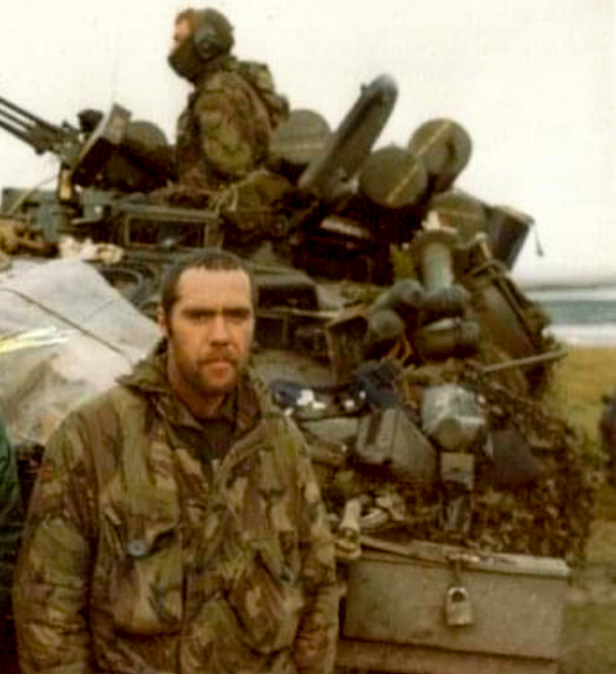
Jimmy’s account begins with the rapid deployment following the invasion on April 2nd, 1982. 3 Para was the spearhead battalion for the army and the lead parachute battalion group, already on notice to move. While there was no time for pre-deployment training for the entire battalion, they had conducted intense live firing exercises up to company level with support arms the previous year, which proved invaluable. The swift departure of the carrier group highlighted the rapid mobilisation effort. Information on Argentinian forces was scarce initially, with intelligence trickling down from Marines who had been on the islands during the invasion. Despite the potential for a political solution, the soldiers were focused on preparing for war, whether to fight or garrison the islands. This mindset, influenced perhaps by leaders with Second World War experience, favoured action and adapting as they went.
Journey South
The journey south involved continuous training on board the crowded vessel, covering basic infantry skills, map reading, and battlefield first aid. Ascension Island proved to be an invaluable stop, serving as a logistics base and providing an opportunity for crucial training, including firing all weapon systems and incessantly practicing assault craft landing drills. The battlefield first aid training was basic, focusing on breathing, bleeding, breaks, and burns, using simple field dressings familiar to soldiers from WW2. The concept of regimental aid posts (RAPs) in the Falklands was rudimentary, often just a hollow in the ground near a rock slab.
Ground And Weather
The ground and weather conditions in the Falklands, heading into winter, were harsh. Temperatures hovered around freezing, constant wind was a major issue, and rain, sleet, and snow were frequent. Soldiers were damp at best, and often soaking wet, from the day they landed. The terrain was described as rolling moorland, peat bogs, and rock-strewn mountains with difficult “rock runs” (boulder fields) that hindered movement. This made cross-country travel, especially under heavy operational loads, extremely difficult and energy-sapping. While lower limb injuries like ankle breaks were expected from the terrain, trench foot was the primary cold weather injury. The infamous DMS boot, which was not waterproof and stayed wet, contributed significantly to this problem.
Kit And Equipment
Soldiers carried standard issue kit, including the old KF shirt (World War II leftover) and Arctic string vests, and thin Arctic warfare smocks that were already worn out. The British army’s kit was considered inferior to the Argentinians’ in some aspects, particularly night vision optics. The infantry weapons included SLR rifles, GPMGs, and 84mm Carl Gustaf anti-tank weapons (effective for bunker busting). Optics were limited, with some basic telescopic sights and first-generation night vision devices that were large, heavy, and ineffective in poor light. In contrast, the Argentinians had FN automatic rifles, many with bipods, and often possessed superior second-generation night vision aids.
Landing On The Falklands
The campaign began with the landing at San Carlos Water on the morning of May 22nd. Despite planning for a dark landing, 3 Para landed in daylight, using the same landing craft as 2 Para.
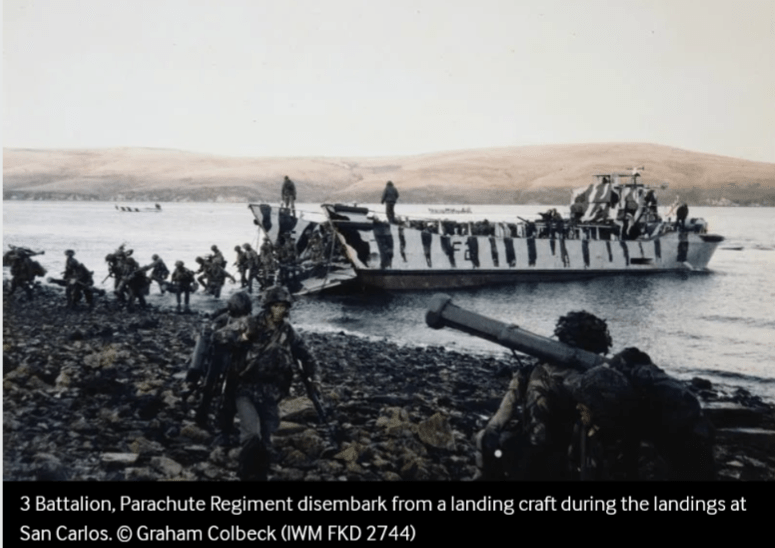
After securing the landing area and digging in, they witnessed Argentinian air attacks on the ships in the sound, which was depressing but also highlighted the urgency to move forward. The sinking of the Atlantic Conveyor, which carried the Chinook helicopters, severely hampered their mobility and forced them to advance on foot across the island. This “tab” was physically one of the hardest things Jimmy had ever done, covering about 50 miles tactically across broken ground with heavy operational assault loads, often without Bergens for days. The advance involved moving in a battalion snake formation, with the patrol company providing flank protection, clearing choke points, and gathering intelligence. They reached Estancia, setting up defensive positions and establishing a patrol base closer to Mount Longdon. The patrol company’s close target reconnaissance on Longdon was indispensable, identifying minefields (which went around the mountain in a horseshoe shape) and the locations of enemy positions, including machine guns, mortar pits, and radar.
The Battle
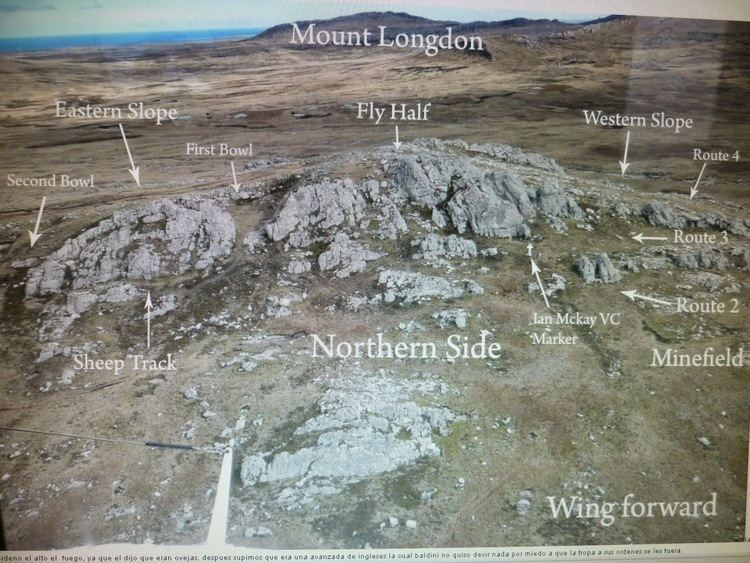
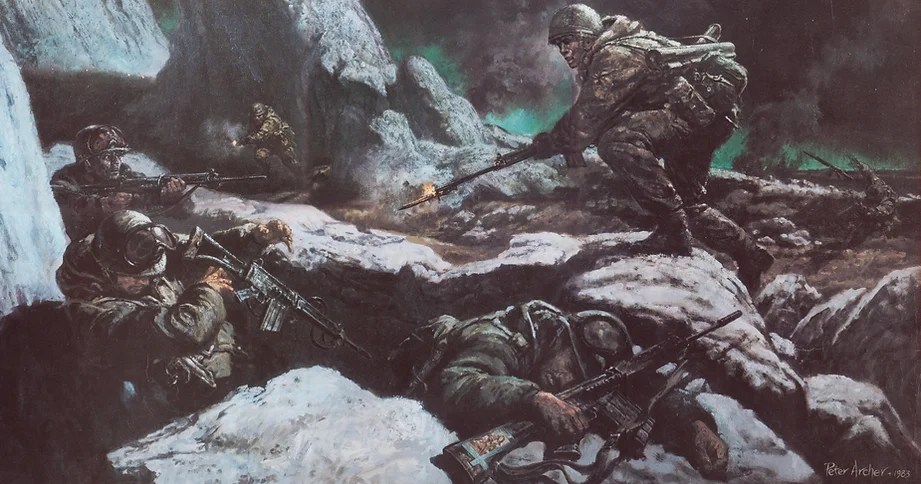
The Battle for Mount Longdon took place on the night of June 11th/12th. Lieutenant Colonel Pike decided on a silent attack from the west, with B Company taking the summit and A Company supporting from a northern spur. C Company was held in reserve. B Company (4, 5, and 6 Platoons) approached in the dark. The battle was initiated when a man from 4 Platoon stepped on a mine, alerting the Argentinian defenders. 6 Platoon reached the western summit with little initial fighting but were later pinned down by bypassed bunkers and sniper fire, suffering casualties. 4 and 5 Platoons fought their way onto the western end using anti-armour weapons but faced heavy automatic fire moving east.
Sergeant I.J. McKay was awarded a posthumous Victoria Cross for knocking out a heavy machine gun post that was holding up B Company. Despite calls for artillery and naval gunfire, B Company took heavy casualties and was halted halfway along the ridge. A Company (1, 2, and 3 Platoons), initially tasked with the northern spur, was pulled back and moved through B Company, clearing enemy positions on the eastern half of the summit with rifle, bayonet, and grenades, eventually securing the feature by dawn. The battle lasted about ten hours.
The Argentinian defenders on Mount Longdon were from the 7th Infantry Regiment, supported by snipers, heavy machine guns, mortars, and artillery. Jimmy described them as well-defended and entrenched, with bunkers integrated into the rock formations. They also had a platoon of Marines with .50 cal machine guns and a platoon of engineers with modern night vision. They had approximately one-third more men than the attacking British company group.
The ground offered no room for maneuver, forcing frontal assaults into killing zones. The lack of effective night vision and automatic weapons put the British at a significant disadvantage in the firefight. The battle quickly devolved into fractured, section-level fighting, with command structures breaking down amidst intense 360-degree fire. Soldiers relied on basic tactics like pairs fire and maneuver and crawling forward to assault bunkers with grenades. Naval gunfire and artillery support were called in on depth positions. Cooks, clerks, and other support personnel bravely carried ammunition forward and evacuated casualties under fire.
After Mount Longdon was secured at first light, the battalion reorganised, recovering casualties and dealing with the dead. Eighteen Paras and an attached Royal Engineer were killed in the attack, with many more wounded. Three more Paras and a REME craftsman were killed in the subsequent shelling. The mountain came under heavy and accurate artillery fire from Argentinian positions near Stanley, causing further casualties over the next two days. Soldiers had to hide in crevices or captured bunkers to survive the barrages, hearing frequent cries for “medic”.
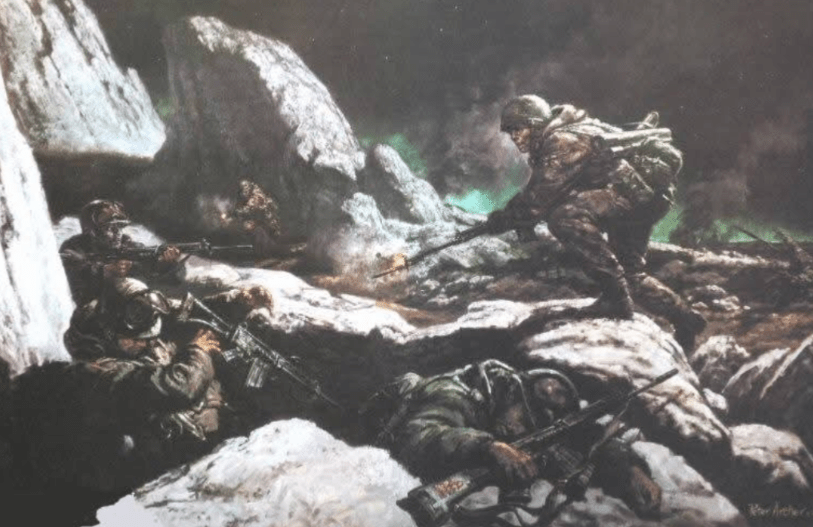
As they prepared for the next planned attack towards Stanley, the news came that the Argentinians were surrendering. This brought a huge sense of relief but also weariness and caution. The battalion moved into Stanley behind 2 Para, remaining alert for potential threats, including suspected minefields. Mount Longdon had been costly, with over 90 soldiers killed or wounded, effectively taking one company out of the battle.
Reflections
Reflecting on the battle, Jimmy emphasized that victory came down to determination, the ability of junior soldiers to continue fighting when leadership structures broke down, and the excellent training level of the troops. Despite facing a well-defended enemy with superior equipment in some areas and limited mobility, the soldiers pressed on. He highlighted the bravery of men who received no formal recognition but were known within the battalion for their actions. The mission always came first, regardless of the cost.
Copyright © 2025. All rights reserved by the Unconventional Soldier blog. No part of this work may be reproduced in any form or by any means without prior permission in writing of the author.
 Unconventional Soldier Blog