
By Kim Read
Introduction
As a member of 4/73 (Sphinx) Special OP Battery I was fortunate enough to be able to attend 8 courses at the LRRPS in the period of 1984 – 1988. The courses at the school were constantly being improved and adapted so other former students of the school might have experienced a different format on their course. Otherwise course content is related to the best of my memory. The description of the training, opinions and experiences, are purely my own and hopefully give an idea how we were trained at the time. I will be using the following abbreviations in this article
LRRP. Long Range Reconnaissance Patrol
BW. Bundeswehr. (German Armed Forces)
BGS. BundesGrenzschutz. (German Border Police)
GSG 9. Grenzschutzgruppe 9 ( Border protection group no. 9)
DS. Directing Staff (instructors)
RV. Rendezvous /check point
The school gave invaluable training and facilities to its students for its time. It also gave soldiers a chance to work with other LRRP soldiers, improve standards, exchange ideas, and be evaluated by the DS of the courses. The level of instruction was excellent and there was a great emphasis on realistic training.
The School
“The whole art of war consists of guessing what is happening on the other side of the hill.”
The Duke of Wellington
Welfen Kaserne (Welfen Barracks ) in the town of Weingarten, is situated in the state of Baden Wuertemberg in Southern Germany and was the home of the ILRRPS there since 1979. It was also the home of the German Army’s Fernspaehlehrkompanie 200 (long range reconnaissance training company 200).
The town incedently, was the site of the start of Field Marshall Erwin Rommel’s military career. Here he joined the 124th Infantry Regiment as a Faehnrich/officer cadet in 1910. He was fully commissioned in 1911 and served there up to 1914. There is a plaque dedicated to him by the soldiers of his regiment in the town. I was quite surprised to see the plaque as the opinions on Rommel are divided in Germany as to his role in the Third Reich, also these places can become meeting points for extremists. However the plaque is not exactly obvious so maybe that is the reason why it has survived.

The barracks were the same as used by the Bundeswehr recruits in the camp. Modern, functional, divided into 6 man rooms. An unusual administration point was, that British students received a pay supplement, paid out on the course as the German food served by the Bundeswehr did not supply the sufficient calories recommended by the British Army.
Throughout the British Army at the time, the soldiers could expect the luxury of bacon, beans, eggs fried, scrambled, boiled etc plus cereal, toast and tea, the full English breakfast in all its glory, every morning. The Bundeswehr breakfast was spartan to say the least. Cereal, a boiled egg, bread rolls and luke warm coffee, watched over by a hawkeyed German Army cook. Its appearance was summed up best by the reaction of a huge quarterback size, African American student who, seeing the breakfast for the first time, exclaimed ‘fuck! is that all that’s left, I didn’t realise I was late? “… I explained that is the breakfast..’ muthafucker! I’m gonna die here! he gasped. He, however survived the calorie culture shock, did not die, and was a great help to us later on one of the courses.
For those who wanted to increase their calorie intake the Casino, the German army term for bar/cafe/recreation center on barracks produced very good meals, but naturally paid for out of one’s own pocket . Hence the pay supplement for the British contingent.
Every course would start with introduction of the instructors, an address by the school commander, followed by a fitness test. As far as I remember the test was based on the British Army basic fitness test, 3 km as group, 3 km individual effort. The test dress was t shirt, combat trousers, boots. The last phase was very competitive, national and unit pride kicked in, everyone giving maximum effort, even though fitness standards were high, no one wanted to have the dubious honour of last over the line. The only course that did not require you to do a fitness test was the Warsaw Pact Recognition course. It was required of Special Observer soldiers at the time to complete their training, that we should attend and pass the following courses at ILRRPs.
You can listen to our podcast on the ILRRP school via the Spotify link below.
Warsaw Pact Specialist Recognition Course
“Know your enemy, know his sword.”
Miyamoto Musashi
One of the most intensive courses I have attended in the military has to be the Warsaw Pact Recognition course. Throughout our training we regularly did AFV recognition. Along with communication, it was one of the core skills of every member of the battery and essential in our mission to locate, identify and communicate targets back to our artillery, so they could be destroyed.
On this course it was not enough to recognise a vehicle from a simple front or side view, in good quality pictures. We were treated to obscure imagery of AFVs, in fog, from the air, half hidden under camouflage netting or taken secretly in gloomy vehicle sheds. What are its variants? Can you recognise it by its thermal picture? What if it is covered by a tarpaulin, what gives it away? Slides of vehicles were flashed on to a screen for a few seconds, in which we had to recognise the vehicle or its variant.
This was not limited to armoured fighting vehicles but support vehicles, engineers, bridging equipment, communication vehicles and various antenna configurations. In fact all vehicles used by the seven Warsaw Pact nations. There was over 200 types of equipment listed in the school recognition book which was issued to every student on the course. This book accompanied you every day on the course. It would be interesting to know how many of these were rapidly brought out of storage and used as reference by past students as they watched the news during the opening phase of the Ukraine conflict.

The most impressive examples of imagery and recognition skills were often supplied by the various NATO military missions. Driving past columns of Warsaw pact vehicles the operators would be reeling off a real time commentary of every vehicle and its variant as fast as auctioneers at a cattle market.
Order of battle was also on the agenda. Order of battle is the study of the construction and organisation of various units and sub units of the Soviet Army and how they work. This in combination with the recognition of signature equipment, gave an insight into what was developing before you on the battlefield. Signature equipment if seen in certain groups could indicate at which level the attack was taking place. Uniforms, rank and unit insignia of the Pact were also included in the course and just so you didn’t get bored, the Cyrillic alphabet was also taught, so you could decipher captured Soviet Maps.
Hours of doing homework were spent after the end of instruction for the day. The course supplied us with a projector and slides in the evening so we could test each other and concentrate on improving our recognition weak points. This course, in my opinion, was one of the most demanding at the school. The school also offered a Recognition Refresher course where soldiers who had attended the initial recognition course could be updated on development’s in the Warsaw Pact, the main difference for the refresher course was that it was only one week long. As far as I know there was no equivalent recognition courses for reconnaissance units , anywhere, in any other NATO nation at the time.
Battlefield Survival Course
‘… a sergeant shouted “Every man for himself – make your own way to Dunkirk!..’
Sgt Bernard Kaye R.E. 16 Assault Squadron, France 1940
Battlefield Survival concentrated on the scenario that you were separated from your unit and would try make your way back to your own lines. At this point the soldier would have his first line and second line equipment with him. (first line being equipment carried on person, second line his webbing fighting order. His third line, the rucksack could have been destroyed if he was vehicle borne or abandoned if he needed speed. The soldier then could be dependent on what he carried in his pockets or fighting order. It was standard in the OP Battery to carry some form of emergency ration on the equipment. The content of this ration was left up to the individual.
Another possible problem could be the loss or damage of the soldiers personal weapon or lack of ammunition. They may have the opportunity to arm themselves with a weapon found on the battlefield. So foreign weapons training was provided on the course. Weapons covered were the G3, UZI, M16, AK47, RPD Lmg, SKS, with the opportunity to live fire these weapons on the course.

The course was heavily oriented towards survival techniques. Shelter, fire, foraging, navigation, first aid and survival medicine. The first week’s instruction was in barracks, in the classroom. The second week took place in a survival area where shelters were built and the practical skills of survival were demonstrated and practiced. Battlefield Survival could depend on speed of movement to exfiltrate back to your own lines, which was the opposite of a survival situation. In this case it might be necessary for the soldier to hide for longer periods and wait for the right opportunity to get back to their own lines. Another possible scenario was that they would link up to local forces or resistance groups.
The culmination of this course was an exfiltration exercise in small patrol size groups designed to put you under pressure to cover distance. The greater distance you achieved, the harder it was for the enemy to concentrate his forces to intercept you. If Warsaw Pact forces had invaded Europe it was very likely many troops would be cut off after the initial advance. So the Battlefield survival concept was a very realistic situation that any soldier could find themselves in. However the next course was to cater for the worst case scenario. Capture and its consequences.
Escape & Evasion Course
‘… the two VC pulled my equipment harness from my shoulders, grabbed my arms, and quickly tied them behind me, once at the elbows, once at the wrists,” Di!/Go! ” They threw me down the path.’
Lt. James N Rowe. Green Beret, Vietnam 1963
This course was specifically aimed at prone to capture personal, who found themselves working behind enemy lines. On my course I had, apart from 4/73 Gunners, British Airborne Recce, an RAF SF flight crew, US Army helicopter crews, German Kampfschwimmer(military divers) and Belgian Paras. The instruction was more orientated to avoidance of capture and the worst case scenario of becoming a prisoner of war, and if captured, escape. Escape tools, lock picking, insights into interrogation techniques and case studys of those who have experienced capture, taken as a hostage or interrogated were among the many subjects on the course.
We also received excellent lectures from the British Joint Service Interrogation unit. These covered the guidelines for soldiers in captivity, and how to react under interrogation. The British policy at the time was only to reveal the “Big Four” : Name-Rank-Number-Date of birth. Any other question was to be answered with “I can not answer that question, Sir” The best option was to hope if capture came, one was thrown in with other prisoners and blend into the mass of prisoners of war and appear of no intelligence value to the interrogater. If you were caught in the area of the front line maybe a feasible option. However, behind the lines you would be of special interest to any interrogator, regardless of what story you offered to your captor. In that case the best what one could hope for was to last for 24 hours and then release a cover story or trickle out useless information to satisfy your captor. As with all the courses, after the theory came the opportunity to put things into practice.
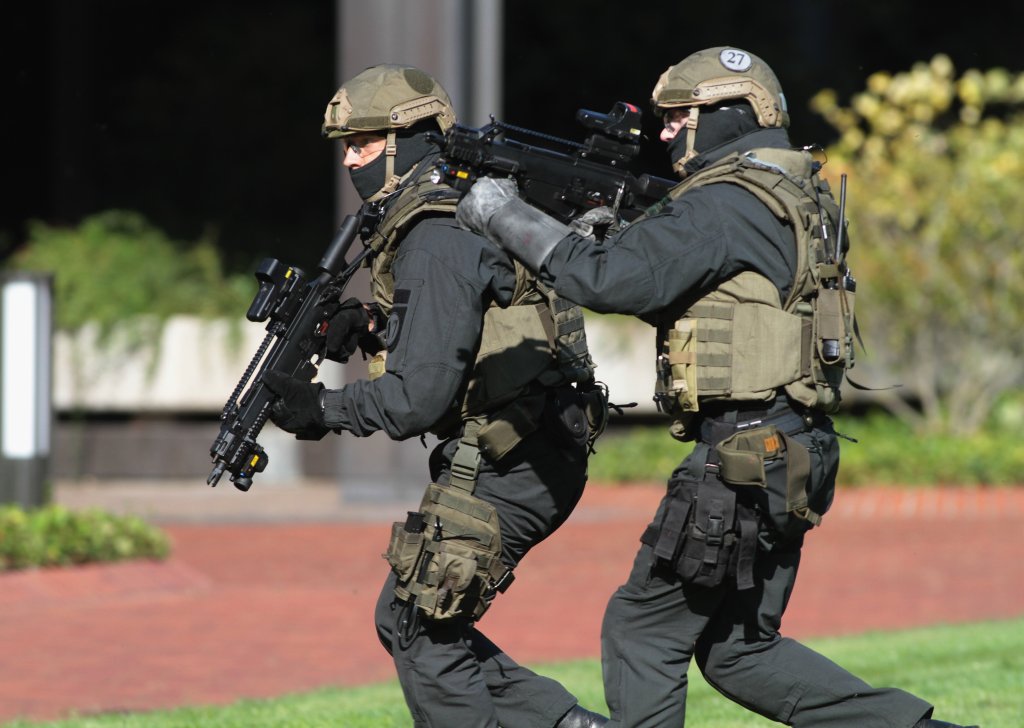
For every E&E exercise there was a hunter force. The hunter force were vital, their enthusiasm to capture as many as possible put pressure on the escapee and made the exercise more realistic. The force could consist of any military unit, active or reserve with the manpower available. Most units were only too keen to take on the task. On my course we were lucky to have the Irish Guards and GrenzSchutzGruppe 9, better known as GSG9, as hunter force. GSG9 were the Anti Terrorist Unit of the Bundesgrenzschutz (border police). They were formed in 1972 after the failed German police rescue attempt at freeing Israeli athletes being held hostage at the Munich Olympics. The local police were unprepared for this type of incident and it led to a disaster at the Fuerstenfeldbruck Air Base. In the aftermath it was decided to form a specialist anti terrorist unit. Within a short time GSG9 had gained a formidable reputation. They were well equipped, well trained, and one of the best at what they do. They were regarded highly internationally and were then Germany’s only special force unit.
Prior to the Evasion exercise comes a preparation phase. We were given large rolls of sacking cloth to make improvised clothing or rucksacks. The most popular design being a waistcoat with poachers pockets or rucksack. Also we received silk cloth strips to make an improvised escape map and a map of the area. For the exercise we were allowed, a penknife, means of starting a fire, a water carrier and small compass.We would be carrying an exercise ID card with emergency telephone number plus some small change.
Also we had to give up some civilian clothes, a jacket or pullover and pair trousers were the only items allowed. In the bag containing the civillian clothes we placed an envelope with 5 DM (Deutsche Mark /German currency pre Euro) which we would receive at an agent RV on the exercise. We also had mug shots taken of us for the hunter force so they could identify us. These were then printed out on photocopy sheets, the quality of the photos was purposely made bad so the hunter force would not have it that easy when it came to identifying us. We were then divided into pairs, usually with a member of our own unit.
Any food underway had to be foraged or begged for. For cooking purposes each pair received a large used food can, with a wire for a handle. We were then issued our POW clothing. An old German conscript BW grey green uniform with the large letters ‘POW’ (Prisoner Of War) in yellow across the back. The uniform is made of thickly woven cotton. Robust, fairly warm, but when wet it was like wearing a soaked sail canvas. We were also allowed a pullover and wool hat. During the last 48 hours prior to the exercise, the exercise area was revealed to us, so we could make our own escape maps of the area on silk cloth strips, supplied to us by the DS.
“In my group we had two American helicopter pilots, one was from Alabama. He volunteered to deal with the chickens. He would first sooth the nervous bird, then dispatch it in the blink of an eye, breaking its neck by a barely discernible twitch of his wrist. Calmly and without fuss.“
Kim Read
On the morning of the exercise we were assembled and our persons & kits searched. If anything that was not on the escapee equipment list was found, it was removed. You had to be very imaginative to get past the DS search. Seams of clothing were closely scrutinised, as well as boots, laces, headwear. If not found then you could keep it after the ‘don’t get caught’ rule and the DS asked us after the search if we were successful getting past the search.
I managed to smuggle flattened soup stock cubes in my improvised rucksack,and I had scraped out the inside of the plastic grip of my penknife and placed money there and glued it back onto the knife. My partner had swallowed money the night before, a note folded over & over until it fitted into the tip of a condom. In fact, the tip of two condoms, as stomach acid can eat through the first condom within 24 hours. For all the survival skills one may have or a comprehensive escape kit, money was one of the more useful items you could have as an escapee.
We then moved to a survival area. We had been put into pairs for the exercise and in the area we formed four man groups for shelter building and issue of food. Food was one chicken and a few potatoes, rationing made simple. In my group we had two American helicopter pilots, one was from Alabama. He volunteered to deal with the chickens. He would first sooth the nervous bird, then dispatch it in the blink of an eye, breaking its neck by a barely discernible twitch of his wrist. Calmly and without fuss. It was like watching Death at work. “Its all in the hands, y’all. Gotta have the feeling, just like flying.” he said in his Southern States drawl. In addition to his talent for dispatching chickens, both pilots had a good sense of humour and it was great to work with them.

From the survival area we were to be transported at night to a new area. But it was common knowledge that the transport would be ‘ambushed’ giving us opportunity to escape. Once ambushed and out of the vehicle, we were now on the run and the first priority we had was to establish where we were. This was where time and patience spent on making a detailed escape map paid off. Our last orders were to go to a contact RV. RVs were usually placed near features that one could easily find at night. In this case, a church in a particular village at a certain time , where we were to meet our contact. The church had chimes so one could meet at the agreed time as we had no watches on the escape phase. Watches would most likely in reality be removed by your captors, and the possibility of selling, bartering the watch on the exercise was no longer feasible.
These RVs gave the DS a way of monitoring our progress, safety checks and providing us with information for the next check point. They simulated an escape line run by resistance forces. Shortly after we were on the run my partner announced he had to answer a call of nature and disappeared behind a tree. After a few minutes he came back triumphantly waving a 10 DM note. He also confirmed that the first condom was indeed, in a poor state, another 12 hours and the second would have been eaten through. We now had the vast fortune of 15 DM between us, but cold and hungry and still clueless to where we were. So we set off in the direction of the nearest collection of lights we could see.
Every German village or town has a large sign stating its name at the entrance to the town and often a mention of the next town on the route. After a bit of searching we found the sign and luckily the town was on my escape map. Location established we moved out of the village and passed by an amazingly well organised vegetable garden in the dark. We thought about ‘requisitioning’ some vegetables. It was tempting, the vegetables were only a few paces away, the produce planted in neat rows, the soil raked, everything in perfect order, but any irregularities would be immediately noticed, our footprints easily seen.
We then spied the compost heap. The talented gardener of this plot had thrown the smaller less worthy vegetables away. So we decided it was easier to take from the heap than the garden, less appetising to look at, but less risky. We gathered some mouldy carrots, parsnips as well as onions and retreated into the woods. There was quite a bit of food available at this time of the year, orchards were many, and there were maize fields everywhere. Here, we were moving across a terrain consisting of dense woods interspersed with typical farming countryside.
Meadows, hedges and ditches. There came the point where we had to stop and rest. The question was fire or no fire, it was now daylight, but foggy, so we risked a fire to boil water to fill our water containers and made a soup with our vegetables from the compost heap and also some maize we picked. However the maize was the type that was used for animal feed, and had to be boiled to destruction to make it edible. The smuggled stock cubes were worth their weight in gold, giving the soup real taste, a great moral raiser.
We risked moving through the thickest part of the forest until we met up with a Para Rgt pair. We decided to try and move together that night and cautiously moved up to the edge of the forest where we tried to recce a route for the night. As we were discussing our next move we heard shouts and vehicles. The hunter force were pouring in to the wood. We also heard the barking of dogs. If these were guard dogs they would be impossible to outrun. We burst and ran in all directions, the dogs could not follow us all. On the other side of the wood I could no longer hear the hunter force, but spied one of the Para Rgt guys, where we joined forces. We waited to see if any others would turn up, but no one did, so we left the area.

We walked on through the day keeping off tracks and moving deep in the forest and by late evening we were approaching a small village. We were walking on a small, deserted, foggy road, it had a ditch on one side if any vehicles came, for cover. Then before us in the mist, parked to one side was a dark van. Immediately suspicious we stopped. It could be a romantic couple ‘enjoying’ the damp, foggy, cold drizzly evening or it could belong to the hunter force. I tried to make out the number plate, as all Bundesgrenschutz vehicles registration started with BG.
But in the next moment we got our answer. The vehicle seemed to explode with people, figures burst out running. The beams of the torches attached to HKMP 5s were everywhere. HALT! STEHENBLEIBEN! (Stop! Stand still!) was repeatedly shouted at us.
We turned and ran. We could hear them behind us but we were determined not to be caught. Then through the mist we heard the roar of a vehicle engine and saw the glow of flashing blue lights coming towards us. We automatically peeled off. Running in opposite directions. We turned off the road and I somehow leapt over the ditch and wire fence in one. I was fit, but never agile so how I made that obstacle is still a mystery to me. I landed in a grassy field that led to a wood. If I could make that I’d be safe. I heard the twang of wires as two GSG 9 jumped the fence behind me, but I was well ahead. There was a small rise in front of me, I could see the tips of fir trees ahead, once there I could disappear into the darkness. I was feeling quite elated, I was outrunning one of best anti terrorist units in the world! Ha!
‘In a battle between the bear and the alligator, the terrain decides the winner.’
Native American Proverb
Then I found myself self in a freshly ploughed field. The earth stuck to my feet and I tripped in the furrows. It felt like I was wearing weighted snow shoes. I became slower and slower. Then heard panting behind me, which got louder and louder. The next moment I was poleaxed by a MP5 butt landing between my shoulders and landed face down in the mud. I was knelt on by two GSG 9 police, who very efficiently plasticuffed me, hands behind my back. Then I was half dragged and frogmarched down to the road, both of my captors not too happy that I made them run after me. I was marched down the road into the village just a few hundred metres further. The main road was lined with various GSG9 vehicles, blue lights flashing and border police in dark overalls, all armed. Sitting cross-legged on the road, cuffed, was my Para partner. I was placed on the ground few metres from him. His route selection had been as optimal as mine. He ran into a 45 degree enbankment and was caught scrambling up it.
The village naturally had never seen so much commotion, we were sitting in the road opposite the village Gasthaus (pub) and people gathered in a large half circle around us. One of the GSG9 police was trying to disperse the crowd with the German equivalent of ‘move on, nothing to see here’, which was a bit hard to sell since the street was full of various vehicles with flashing blue lights, armed anti terrorist police, some in balaclavas, and two very dubious dishevelled handcuffed characters sitting in the middle of the street.
Only a few weeks before a leading German news magazine had done a full colour feature on GSG9 and its anti terrorist role, so most assumed this was a real internal security matter. I remember one of the spectators, a tubby middle aged male, grinning, shaking his head in contempt. No doubt thinking two more members of the Red Army Faction (a Marxist terrorist group active in Germany at the time) had been taken off the wanted list. He would sleep well that night, Germany was now a safer place we were in custody!
After some time we were bundled into a van and taken to a huge barn which was the GSG9 HQ for the exercise. We were led into the barn. Inside there was a large contingent of GSG9, all standing around. We were led into the middle of the structure under a very bright fluorescent light. The plasticuffs were removed and we were told to put our hands on our heads. It was silent apart from two BG police who questioned us and compared us to the mug shot photos. The only question they asked was what unit we were: “You are SAS? Pilot yes? Amerikaner Green Beret? Belgique Kommando?” I was thinking, that if I told them they would not believe me or be terribly disappointed (Gunners were not exactly on the glamour list of behind the lines units) . We just replied with standard: “I can’t answer that question” over and over.
After a few minutes, we got the command: Strip! We did, to our underwear, just to be barked at: “Your pants too! “, so we took our underwear off and ended up naked in the middle of the barn, hands on head. We tried to appear indifferent but it was cold, very cold in fact, there was frost outside and we started to feel it. In the meantime apart from a few whispers the others said nothing. The cold was becoming very uncomfortable and we were shivering. In some ways this was one of the more realistic moments. It was unexpected, uncomfortable and we had no control over the situation. We kept wondering how this would develop, I had the feeling they were organising something. Then came into the barn, with perfect timing for us anyway, what I took to be the Commanding Officer of the unit and his Second in Command. He certainly had presence. He glared at his men and wanted to know what was going on. There was a hushed one way discussion with one of his men, then minutes later someone brought us cardboard to stand on and our clothes brought back to us and we were told we could dress.
We were informed that we be taken to the DS control RV. Plasticuffed once more we were placed in the back of a armoured Mercedes Limousine. The driver and co-driver consisted of the Co and his 2IC. The Mercedes had MP5s in holders on the inside of the door, though naturally removed in the rear seats. Though we were cuffed, hands behind back, strapped in. The centre consol of the vehicle had an impressive array of telephones and communication equipment.They drove off at breakneck speed through the winding foggy lanes and delivered us to the DS. At the DS check point, we were asked what happened. I mentioned that they asked us about units. The DS told us “They know about the school but are mega curious about who is on the course, as we don’t tell them anything about units or who is at the school, and by the way, their boss came in the nick of time, they wanted to hose you down in the courtyard!”
We received our civilian clothing and money, given our next RV and were then dropped off separately, the last phase we were to be alone underway. The next RV was a town on the banks of the Bodensee, one of the most scenic lakes in Southern Germany. lt was quite a distance, I decided not to risk public transport and went by foot through the night. I made good progress and arrived there as it was getting light. I noticed a kiosk, a small German corner shop. It was not yet open. I could get milk, crackers, chocolate here. The prospect of food, was all tempting so I sat on a park bench and waited until the kiosk would open. It was strange being in civilian clothing and this perhaps led to a false sense of security.
For the last few days we had avoided contact with anyone, carefully considering each phase of the journey. Now I was walking out in the open. It gave just a hint of what it must have been like for escapees in WW2, all reinforced by the knowledge that on the south east bank of the Bodensee is Switzerland. The tension must have been incredible for those allied escapees making their way to the Swiss border. Moving amongst the enemy population where the slightest slip could lead to your arrest. Most E&E exercises in UK are carried out in remote, arduous terrain. It has been suggested the LRRP school course is easier. I spoke to a pilot from one of the SF flights who did this regularly. He said the UK courses were set in arduous terrain which was challenging , but considered the Weingarten course more realistic, with more situations to cope with. The pilot told me about the encounter he had with GSG9.
The Pilot’s Tale
“You are placed in a position which at first seems not too challenging, after a few minutes it becomes unpleasant. You start to slump, which is immediately corrected by the handling force. Cramps and aches set in, it is now painful.”
Kim Read
On the last day of the Evasion phase, GSG 9 would only be active up to 06.00 of that morning. The pilot had opted to catch a bus to the last RV. He found a bus stop and sat in the sun alone. He had about a 30 minute wait until around 06.00 when the bus came. This was not the first time he had to do RTI training and this time he was going to do the interrogation relatively relaxed and not exhausted.
While sitting at the stop a armoured Mercedes passed, slowed down, turned round and came back. The window wound down and in it were 2 BGS police. They checked their mug shot sheets and spoke into the radio. The pilot said if he ran he’d be caught. It was one long road, with no turn offs. Minutes later two other Mercedes turned up full of GSG9. They were not sure as to whether they had the right person and they kept passing the mug shot sheets around, discussing at a distance and eventually they walked over to him. “Identification please” they asked.
The pilot said he could speak no German, but passible French. So babbled back in French,and thankfully none of GSG9 there could speak French. He was hoping he could pull the affronted Frenchman act off, when he heard from behind in French “Can I be of help Monsieur?” In the meantime two old German ladies had turned up and one spoke a a little French and offered to translate. The pilot said he didn’t have papers, he was on holiday and in France he didn’t need to have them on him, Germany, he assumed, was after all no police state!
The old lady translated everything and rebuked the GSG9 for harassing tourists, “It’s not like ‘then’, think of the impression you are giving! ” she said. The GSG9 group looked at their watches, it was nearly six, Some grinned, apologised and left. One of the BGS Mercedes had held back, and as the bus came, and the pilot started to board the driver of the BGS Mercedes wound the window down and said in English “If you are on the escape exercise, Good luck! ” And drove off.
Most will remember the scene from ‘the Great Escape ” where the escapee in civilian clothing is caught out by the Gestapo by being wished good luck in English. I asked the pilot how he he reacted, he answered “It did irritate me, but I mumbled ‘fuck off’ and got on the bus! ” Whether the GSG9 man had ever seen Britain’s favourite Christmas film is doubtful, and the wishes were, hopefully genuine.
But I digress. I reached the last town early in the morning. There were just a few dog walkers, street cleaners, the occasional jogger. Two joggers ran past. Then I noticed one had Ron Hill brand running bottoms on. Virtually the ‘uniform’ running pants of Army, civillan runners in UK, but unknown in Germany. I looked around and noticed two more suspect looking plain clothes hunter force trying very hard to not look directly at me. Quite a clever tactic, but being Guardsmen they stood out even in civilian clothes.
I departed the area as fast as I could which involved a chase through the streets and only evaded capture a second time by ignoring very much the ‘private’ in private property, as I ran through several gardens. Luckily I was not seen and as I approached the centre of town, I saw the unusual site of the Irish Guards carrying out uniformed armed patrols in a German town, which the local population seemed to take in their stride. Rather a bizzare site, a taste of Northern Ireland in Southern Germany.
The Irish Guards patrolling was very effective. It took a lot of patience to avoid their patrols to get to last RV. Once at last RV we were met by the DS. Our final pickup was on the other side of Lake which belonged to Germany. To cross it we had German Army Pioneer rubber paddle boats. We were briefed on the safety aspects, then, the command, whatever happens on other side do not run. We all knew we were entering the resistance to interrogation phase. We paddled across the lake at night in silence, a weird feeling, behind us the lights from the picturesque tourist town reflecting on the lake, in front the dark banks of the other side. After dragging the boats ashore on the German southerly bank, we were led to a parking area.
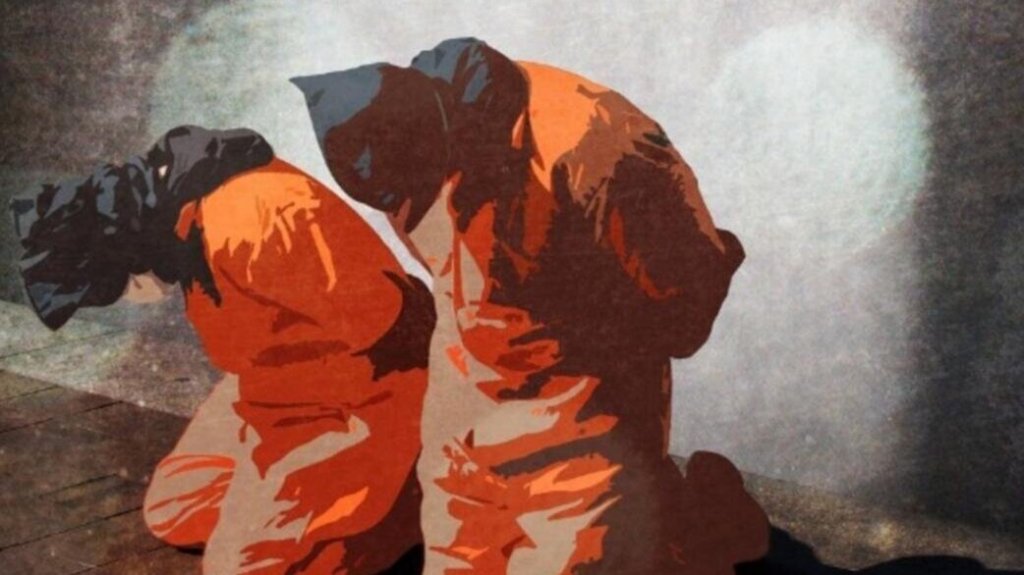
Headlights from several vehicles came on and the command came to lie down on the icy tarmac. One by one we were searched in utter silence, blindfolded, led to a truck and guarded. There is hint of the shock of capture in this moment despite it being an exercise. For the last couple of days we were moving freely, making our own decisions. Now we were all thinking how we would cope with the next 24 hours. Once all processed we were driven to the Interrogation Center. We had to hand our clothing in and were ordered to change into prisoners overalls. Mine were two sizes too small, had ripped kness and chafed crotch and armpits. It was comforting to know that the QM of the interrogation centre was obviously British Army.
I won’t delve too much into the Interrogation phase. A lot of its secrets are out through certain TV shows and are now common knowledge, when 24 hours are bundled into an hours entertainment. However its one of those things you feel accomplished to have done, but would not necessarily want to do again. I found it to be an extreme test of patience. The stress positions are without doubt the worst part. You are placed in a position which at first seems not too challenging, after a few minutes it becomes unpleasant. You start to slump, which is immediately corrected by the handling force. Cramps and aches set in, it is now painful. Just as you think you can not hold it anymore you are moved to another position. The relief is immense for the first few minutes, then it starts all over again, cramps, aches, correction. Over and over for 24 hours. However physically fit you are they will affect you.
The Interrogations are welcome breaks, as they provide mental stimulation amongst the white noise and stress positions. You are blindfolded all the time. Some manage this treatment better than others. Some try to keep track of time while others will do mental exercises. Some have had hallucinations. Our helicopter pilot from Alabama was so convinced he could see people lining up for coffee and dounuts (through his blindfold) he didn’t want to miss out, and started to line up.
The prisoner handling force, also supplied by the Irish guards, put him against the wall again and brought him back to reality! Eventually there comes the point where you are led into a room and an umpire asks you “Do you recognise me?”.When the answer is “Yes” you will hear “The exercise is now over. Well done, you have passed.” The fact you are asked if you recognise the umpire was important, as some believe it could be a trick by the interrogaters and refuse to come out of resistance mode. You had to trust only umpires consisting of course DS.
You are debriefed immediately, then led out into daylight, a hot shower and clean clothes. We were then treated to special breakfast in the camp meal hall. It really was at the other end of the scale in comparison to the normal Spartan breakfast. Only trouble was that everyone’s stomach had shrunk and after a bread roll and boiled egg, most were full. With the completion of this course the six weeks I spent at the school sadly came to an end.
I later returned to complete the school Patrol Course, Patrol Leaders, LRRP Medic and CQB course, which I will cover at a later date.
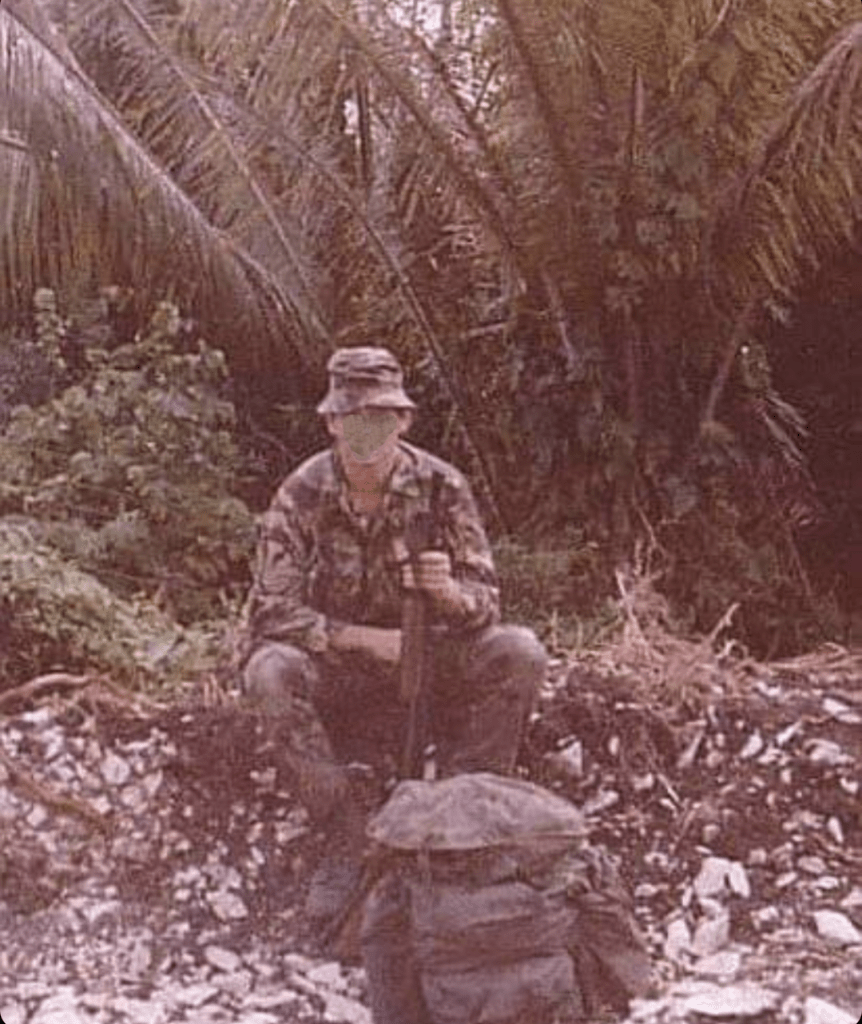
Kim Read enlisted in the British Army 1974 at the age of 16 joining the Junior Leaders Regiment RA based at Bramcote, UK. On the completion of training he joined 32 Light Regiment RA in Bulford UK and trained on the 105mm Pack Howitzer. Later the Regiment’s role changed to guided weapons where he trained on the Blowpipe anti aircraft missile and later became a Swingfire anti tank crew commander. He volunteered for Special OP Troop selection joining the unit in 1986 until he left the Army in 1992. During his service Kim completed tours in Northern Ireland, Belize, Cyprus, Germany, Gulf, Canada, Turkey and points between.
Copyright © 2023. All rights reserved by the Unconventional Soldier blog. No part of this work may be reproduced in any form or by any means without prior permission in writing of the author.
 Unconventional Soldier Blog
Went to the school in the late 70s I think, I do recall the DS were many of those who did the Embassy job in london, then got sent here for a “rest”. Gashed and broke a bone in my foot during the swim, which ended up infected, the CO had me taken to the local hospital and paid for my treatment out of his own pocket. I think it was a guy called Vince and another guy who were arguing who was going to stitch me up lol. Should have been a good time, but thanks to a few guys being led by some short arsed prick, it did not go as well as I would have hoped. Almost ended in a fight with the DS.
LikeLike
First time I met anyone from Hereford was at the school. All excellent with the exception of one who obviously didn’t want to be there.
LikeLike
Sadly on the bus down had a few piss heads that had to be sorted, at the school they started talking shit about me to the DS, till an officer fessed up about what was going on. Drink + Gang mentality = poor soldiers.
LikeLike
This was a very entertaining and informative listen and I loved the book and movie recommendations. I ended up on this page while searching for information about Fernspaehlehrkompanie 200 during the cold war.
Would love to hear from a veteran of the cold war Fernspaeher units on the podcast. I’m also very interested in the East German FJB-40 which seems to have been their equivalent of the Fernspaeher. More info on them here: https://fallschirmjaeger-der-nva.de/
Maybe the author of that site Klaus Dieter-Krug is up for a chat?
LikeLiked by 1 person
Hi Michael.
Thank you for listening to the pod and taking time to comment on the blog. I hadn’t heard of that East German unit and will definetely look at doing an episode on them next year.
LikeLike
If you are looking for an East German equivalent to the Fernspäher the East German Fallschirmjäger are not the guys you are looking for (The Luftsturmregiment 40 was more a general Airborne/Airmobile and Special Forces unit). The LRRP role was fulfilled by the “Spezialaufklärer” http://www.spezialaufklaerung.de/liste_spezialaufklaerung.html.
By the way, Klaus Dieter Krug has sadly passed to my knowledge.
LikeLike
Thank you for the information. Very helpful.
LikeLike