


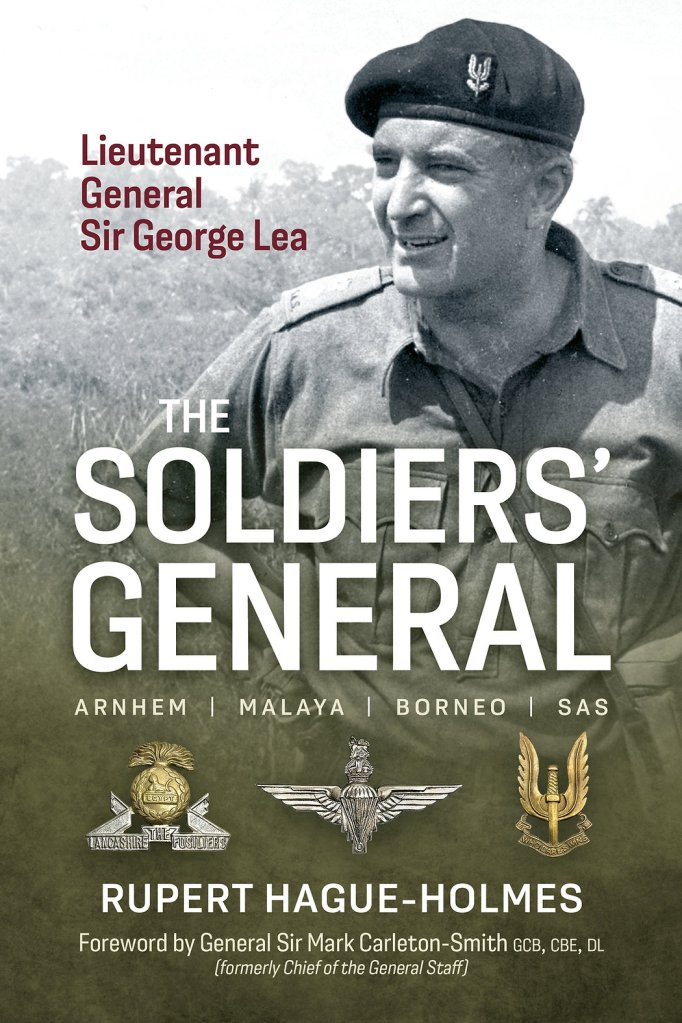
In this episode of The Unconventional Soldier podcast, I discuss the remarkable life of Lieutenant General Sir George Lea with Rupert Hague-Holmes, author of “The Soldiers’ General”.
In today’s world, leadership is often associated with academic achievement, polished CVs, and carefully planned career paths. The life of Lieutenant General Sir George Lea offers a compelling alternative.
Standing 6ft 6in tall, Lea was no academic prodigy. He struggled at school but thrived in the boxing ring, where he developed the resilience, determination, and competitive spirit that would define his military career. Rising through the ranks to become one of the British Army’s most influential leaders, he played a pivotal role in preserving the SAS during a period when its future was uncertain and later became a master practitioner of counterinsurgency warfare.
His story is a powerful reminder that effective leadership is not solely the product of intellect or credentials. Character, courage, adaptability, and the ability to inspire others matter just as much. The life of this “Soldier’s General” offers valuable lessons for anyone interested in leadership in the 21st century.
Presence and Personality
Lea’s career proves that leadership is often innate rather than studied. Despite struggling at Charter House and passing out of Sandhurst in the middle of his class, he possessed a “steely charm” and a presence that allowed him to influence people and events the moment he walked into a room. His success was built on authenticity and a “chameleon-like” ability to adapt to different environments, whether leading Royal Marines, New Zealand SAS, or high-level diplomats in Washington
Leading by Example: The “Tree Jumping” General
Modern leaders often stay behind desks, but Lea believed in sharing the risks of his subordinates. When he took command of 22 SAS in Malaya, he was explicitly forbidden from “tree jumping”, the dangerous specialist method of inserting into the jungle canopy, because the previous commander had been sent home with a broken leg. Within a year, George was tree jumping with his men, taking the view that he could not ask his soldiers to suffer fatigue and danger if he was not willing to do it himself.
Building and Empowering Great Teams
Lea understood that a leader is only as good as the team they build. He was a master at spotting talent, surrounding himself with future rising stars like General Sir Anthony Farrar-Hockley and Field Marshal Nigel Bagnall
- Collaborative Command: His SAS “orders groups” were often more like discussions than rigid hierarchies; he encouraged debate and was willing to be challenged.
- The “Father Figure”: To those under him, he was a surrogate father who prioritised their growth, helping junior officers “grow up” and develop into the next generation of leaders.
Political Savvy and Turning on Strategic “Taps”
During the Borneo confrontation in the 1960s, Lea managed the highly sensitive “CLARET” operations, secret cross-border missions into Indonesia. He demonstrated a sophisticated political awareness, knowing exactly when to “turn the tap” of military pressure up or down to support the government’s negotiating position. He carried immense personal risk on behalf of the British government, ensuring these operations remained effective yet discreet enough to avoid a full-scale war.
Accountability in the Face of Failure
Perhaps the most poignant lesson from Lea is his sense of personal responsibility. He took the heavy losses his battalion suffered at Arnhem in 1944 deeply to heart, feeling accountable for the people he led. Despite his later success, the fact that only 97 of his 571 men returned from Arnhem remained with him for the rest of his life. He didn’t seek fame or excuses preferring to let his deeds do the talking.
The Legacy
Sir George Lea wasn’t just a combat soldier; he was the “custodian” of operational infrastructure. From refining SAS selection processes to establishing the manuals that still influence special forces today, he left the army, and UKSF, better than he found it. For any modern leader, Lea’s “creed” ,a mix of professional integrity, humour, and shared hardship, remains a gold standard for inspiring teams.
Copyright © 2026. All rights reserved by the Unconventional Soldier blog. No part of this work may be reproduced in any form or by any means without prior permission in writing of the author.

